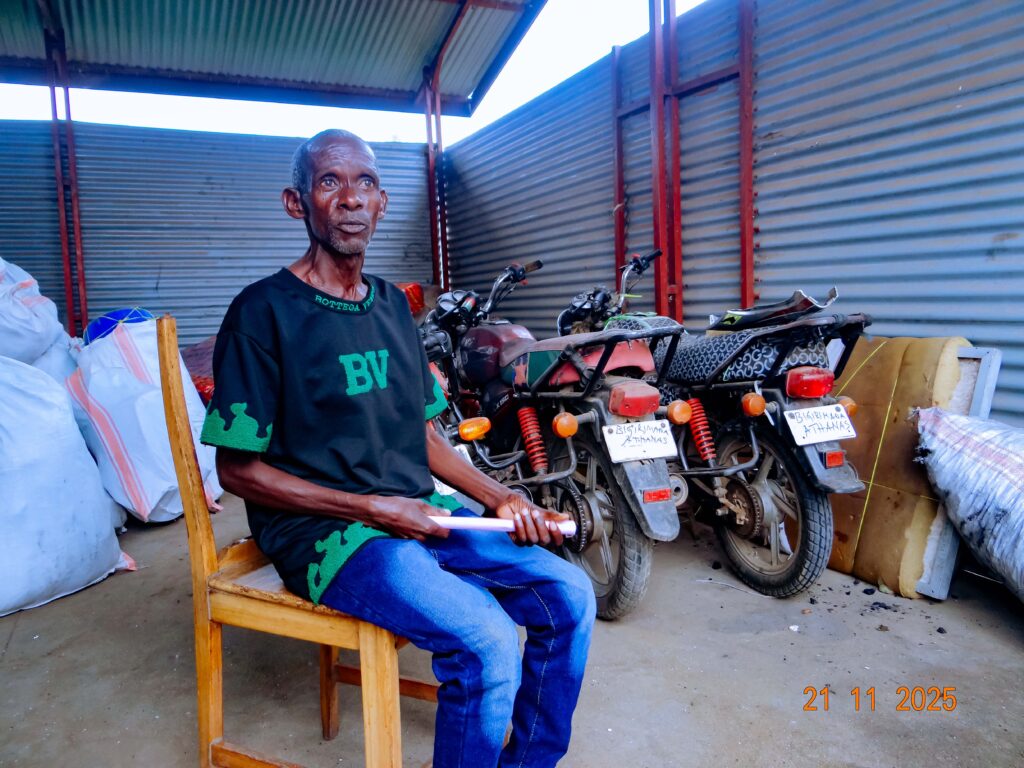
For a refugee, voluntary repatriation is the culmination of a long journey. But for Bigirimana Athanase, 58, his return to Burundi in 2025 came with a unique and powerful dilemma: what to do with the “fortune” patiently accumulated during his ten years of exile in the DRC, as he narrates:
It was not wealth in the usual sense, but the fruit of hard work: three motorbikes, substantial cassava harvests, and the agricultural equipment that had allowed his family not only to survive but to prosper. These possessions were the tangible proof of his resilience and entrepreneurship.
In 2015, at the age of 48, I made a heartbreaking decision: to leave my country, Burundi. With my family of five, we crossed River Rusizi to the Lusenda camp in the Democratic Republic of Congo (DRC).
My passion for agriculture has always been the pillar of my family, ensuring our subsistence and the schooling of my children. Once in the DRC, I knew I couldn’t remain idle. The land in this region is similar to ours, and that is where my determination took root.
I started modestly. Little by little, my supplementary agricultural work, alongside humanitarian aid, allowed my family not only to survive but to prosper. My children grew up working by my side in the fields, acquiring invaluable stability and knowledge. These years were marked by joy: I had the happiness of marrying off my two daughters, which lightened my responsibilities while filling my heart with pride.
Ten years later, our fortune was no longer the same. I had accumulated possessions: three motorbikes, large cassava harvests, fields under production, and a standard of living I never thought I would achieve in exile.
When the announcement of the voluntary repatriation program for Burundian refugees reached us, a wave of emotions overcame me. I gathered my children, now adults and independent, and gave them my blessing to register for the return.
I wondered how I could leave behind the fruits of ten years of labor. When I approached an agent from African Initiatives for Development (AIRD), he told me that “when your turn comes, all your belongings will be transported without a problem.”
I left that office overwhelmed with intense joy. I would not be returning empty-handed. I could bring back the tangible proof of my success in the DRC to reinvest it in Burundi.
The big day arrived. My family and I packed our belongings, and AIRD handlers loaded them onto their trucks.
This return was not the end of our journey, but the realization of a dream: to rejoin my native country, not as a destitute refugee, but as an entrepreneur who succeeded in transforming exile into a solid foundation for the rebuilding of his future and that of his family in Burundi.