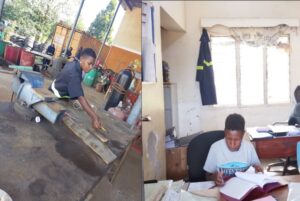
When 19-year-old Wibabara Faraja fled the Democratic Republic of Congo with her family in 2016 due to war and insecurity, she arrived in Uganda carrying very little except hope for a better future.
Life in the refugee settlement was far from easy. Like many refugee girls, Faraja dreamed of continuing her education and building a meaningful future, but financial hardship stood in her way. Although both her parents were alive, the family could not afford school fees. After completing her Primary Leaving Examinations and qualifying to join Rwamwanja Secondary School, her dream of becoming a mechanic still seemed impossible.
For years, Faraja wondered how she would move forward.
Then an opportunity came that changed everything. Through AIRD’s Multi-Skilling Training Programme, implemented in partnership with UNHCR and CFAO, Faraja received a scholarship that opened the door to vocational training and a new beginning.
Attached to the Adjumani mechanical workshop for hands-on training, Faraja entered a completely new world, one where she could learn practical mechanical skills and discover her own potential. Today, she can rebuild engines, adjust brakes, service motorcycles, handle lubrication systems, and conduct mechanical diagnostics with confidence.
The skills she once only dreamed about are now in her hands. Faraja no longer sees herself as stranded or limited by her circumstances. Instead, she speaks with confidence and determination about her future.“I now feel confident and responsible. I can see a future that belongs to me,” she says.
Faraja now dreams of opening her own garage so that she can earn a living and support her siblings. She also hopes to inspire other refugee girls to pursue technical careers, proving that engineering and mechanics are not only for men. She believes the skills she has gained will not only provide income but also redefine her identity, independence, and confidence.
Today, she stands as a symbol of resilience and possibility, a reminder that when refugees are given opportunities, they do more than survive; they rise, rebuild, and thrive. Faraja’s story is more than a testimony of vocational training. It is a story of restored dignity, renewed hope, and empowerment through skills.
One young woman.
One opportunity.
One decision to learn.
And now, one future is being rewritten.
This is the impact of empowering hands with skills.